The Cricbet99 Cricket ID — Registration, Login & Benefits

Everything on this service revolves around one artifact: the cricket ID. This guide explains what it is, the three types you can ask for, what the panel looks like once you are inside, the registration flow message by message, what to do in the first five minutes after login, how the benefits actually compare with a bookmaker account, how money goes in and comes out, and how to check that any provider — this one included — is worth trusting before you send a rupee. It is written as one continuous read, with deeper dives linked at each stage. If you would rather skip the reading and just get set up, the registration page takes about two minutes; if you want it in Hindi, the ID kaise banaye guide covers the same flow.
What an ID includes

The card above is a good summary of the three things that arrive in your chat when an ID is created: a login link (the current official panel domain, which can change from time to time — always use the one the chat gives you), a username, and a temporary password you will change on first login. Behind those three lines sits the service layer that makes them useful — the funded balance, the bonus terms attached to your deposit, and the humans who answer when anything needs fixing.
The distinction worth holding in your head from day one is that the ID is two things joined together. The panel is a piece of software: a betting exchange interface where you read prices, place back and lay bets, watch positions settle and check your ledger. The chat is a service relationship: it is where deposits are confirmed, withdrawals are requested, passwords are reset and disputes are raised. Bookmaker sites fold both into one website with a support ticket form; the cricket ID model deliberately keeps them apart, so the software does what software is good at and a person handles the parts that need judgement. Once you see it that way, every later question — “where do I deposit?”, “why can’t I withdraw from the panel?” — answers itself: money and support live in the chat, betting lives in the panel.
The three types of ID
When you request an ID the chat will usually ask what you want enabled, and the honest answer is that most new players do not know there is a choice. There are three configurations, all built on the same login and wallet; the difference is which parts of the panel are switched on.
| ID type | What is enabled | Who asks for it | Can it change later? |
|---|---|---|---|
| Cricket-only | Sports exchange: cricket, football, tennis, other sports | Players who want the casino lobby hidden on purpose | Yes, one chat message |
| Casino | Live casino and card games; sports hidden | Players who only want the live tables | Yes, one chat message |
| Full | Everything: exchange, sportsbook, live casino | The default if you do not specify | Yes, one chat message |
The cricket-only configuration deserves a mention because it is a genuinely useful self-control tool rather than a restriction. A session bettor who has closed the board after hitting a stop-loss is, on a full ID, one tap away from a roulette table with the same balance; on a cricket-only ID that tap does not exist. Several experienced players ask for it deliberately. It costs nothing, changes nothing about the exchange, and can be reversed whenever you like — but the point is that reversing it requires a deliberate message to a person, which is exactly the friction a tired evening needs. If you are not sure, start cricket-only and widen later.
What your ID panel looks like
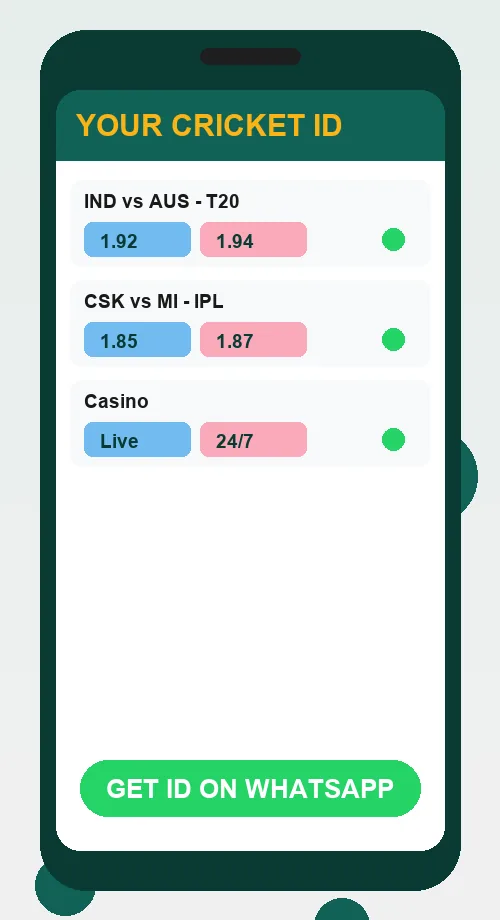
The preview beside this text shows the panel as it opens on a match night, and it is worth walking through the layout before you log in for the first time, because the exchange screen looks nothing like a bookmaker’s neat list of prices.
The top strip carries your balance and your exposure as two separate numbers. Balance is settled money; exposure is the most you can lose across every open bet right now. New players read the balance and ignore the exposure, which is how a full-looking account turns out to be mostly committed. Read both, every time.
The left column lists sports and, under cricket, every live and upcoming match. Tap a match and the centre of the screen fills with its markets: match odds at the top, then the session and fancy board underneath, each with a blue back column and a pink lay column. Those two colours are the whole exchange in miniature — blue to bet that something happens, pink to bet that it does not — and the back vs lay guide is the ten-minute read that makes them second nature.
The right column is your bet slip and your open positions. A bet placed here is not yet a bet until it is matched against someone on the other side, which is why it can sit as “unmatched” for a moment; the matched vs unmatched guide explains what to do when it does. Below that, the ledger shows every settled result with the commission line itemised. On the mobile app the same three areas become tabs, with the markets in the centre and balance pinned to the top.
From zero to first bet

The diagram compresses the whole onboarding into four steps, and in practice that is what it is — but each step has one detail that saves a round trip if you know it in advance.
- Request the ID. One WhatsApp message to the official number: your name, that you want a Cricbet99 ID, and which type. Expect a reply asking you to confirm you are over 18. Within a couple of minutes the login link, username and temporary password arrive. The registration flow is shown in full with screenshots.
- Fund it. Ask for the current UPI details in chat — do not reuse details from an old screenshot, because collection accounts rotate. Send the amount you decided on before opening the chat, then paste the UPI reference number and a screenshot. Ask for the welcome bonus before paying, not after; bonus credit attaches to a deposit at the time it is made.
- Login safely. Open the link, enter the credentials, and change the temporary password immediately — the first-login steps and the security habits cover this. Check the balance matches your deposit plus any bonus before placing anything.
- Start small. Match odds on one game before sessions; sessions before fancy. The odds guide is the ten-minute head start, and the how it works page shows the full loop from deposit to payout in one diagram.
A worked timeline for a realistic evening: message sent at 6:50 pm, credentials received at 6:53, UPI transfer of ₹2,000 sent at 6:56 and screenshot posted, balance of ₹2,000 plus the agreed bonus visible in the panel at 7:02, password changed by 7:04, and a first small back bet on match odds placed before the 7:30 toss. Ten to fifteen minutes end to end, with nothing uploaded and no form filled beyond a chat conversation.
The first five minutes after login
The temporary password is a convenience for the person creating the ID, not a security measure, so the first job inside the panel is to replace it. After that, a short checklist puts the account on a footing that will not cause trouble later.
- Change the password to something you do not use elsewhere. Twelve characters or more, not your phone number, not the username backwards. The panel will not enforce this; you should.
- Confirm the balance line. Deposit plus bonus, and nothing else. If it is short, screenshot the panel and raise it in chat before betting — a discrepancy is trivial to fix before a bet and awkward after.
- Find the stake buttons and set them small. Most panels let you pre-set quick-stake amounts. Set them to your unit size from the bankroll guide, not to the defaults, so a mis-tap on a live market is a small mistake rather than a large one.
- Open the rules link on one market type. Read the settlement terms for match odds and for sessions once. It takes five minutes and it is the difference between a void feeling like a rule and feeling like theft — the settlement guide summarises them if you want the short version.
- Log out of any shared device. The panel keeps sessions alive. If you logged in on a friend’s phone to check something, log out; the chat cannot see who is holding the phone.
Who it is for, and the benefits compared honestly

The card above puts it plainly: the honest fit is players who want more from a match than a single fixed-odds bet. If session lines, fancy markets or trading with the lay side sound interesting, the exchange is your native habitat. If you place one bet on the IPL final each year and never think about odds otherwise, a cricket ID still works perfectly well — it just will not feel much different from anywhere else, because the things that make an exchange special only show up when you use them.
Comparing against bookmaker accounts is where most people’s real question sits, so the table sets the two models side by side without cheerleading. The Parimatch and Betway comparisons go deeper on two specific sportsbooks.
| Feature | Cricket ID (exchange) | Typical bookmaker account |
|---|---|---|
| Bet direction | Back and lay on every market | Back only |
| How the house earns | Commission on net winnings only | Margin built into every price, win or lose |
| Session and fancy depth | Dozens of lines per innings, re-quoted ball by ball | A handful of pre-set totals, often suspended in-play |
| Registration | WhatsApp number, no documents | Form, email, usually KYC upload before first withdrawal |
| Money in and out | UPI via chat, same-day payouts | Card or wallet, with processing windows and minimums |
| Support | One accountable chat, 24/7 | Ticket queue or live chat, tiered |
| Price protection | None — you are responsible for reading the market | Margin hides bad prices but you pay it always |
| Regulation | Offshore platform; state law applies to you | Varies; some hold overseas licences |
Two rows are deliberately marked against the exchange, because a guide that only listed advantages would be an advertisement. The lack of price protection is real: on an exchange a poorly-read lay bet can cost far more than its stake, and no margin quietly saves you from it. And the regulatory position is what it is — the platform is offshore and the law that applies is the one in your state, which the legality page sets out. None of the benefits above matter without limits you actually keep. 18+ strictly.
Deposits and withdrawals, in one pass
Money moves through the chat, never through a form in the panel, and understanding that one sentence removes most confusion. Here is the full loop with real numbers.
Deposit. You ask for the current UPI details and send ₹3,000 from GPay. You paste the twelve-digit UPI reference and a screenshot. The chat confirms and the panel balance reads ₹3,000, plus whatever bonus was agreed — say a 10% first-deposit credit, making ₹3,300, with the ₹300 subject to a turnover condition before it can be withdrawn. Ask what that condition is at the time; the welcome bonus guide explains how turnover is counted so it never surprises you at payout.
Play. Over an IPL night you win ₹1,400 net across three settled markets after commission, and lose ₹600 on a fourth. The balance now reads ₹4,100. Open positions, if any, show as exposure and are not part of that number.
Withdraw. You message “withdraw ₹2,000 to the same GPay” with no open bets. The chat checks the bonus turnover has been met, matches the payout details to the ones you deposited from, and pays. Typical timing is a few hours; same-UPI-ID requests move fastest because there is nothing new to verify. The deposit guide and withdrawal guide cover the edge cases — split payouts at size, bank transfer for larger amounts, and what to do if a reference number is rejected.
Safety: verifying a provider before you send money

The number beside this text is the one that makes new players nervous, and rightly: an ID that takes two minutes to create takes two minutes for anyone to create, including people who will take your deposit and vanish. Speed is a feature of the model, not evidence of trustworthiness. Verification is on you, and it takes about five minutes.
Check the number, not the name. Copycat WhatsApp profiles use the brand name and logo freely. The only thing that cannot be faked is the number itself, so take it from the official page and compare digit by digit. A “new number, old one blocked” message from an unknown sender is the most common scam opening in this space.
Ask for the ID before you pay. A genuine service issues the login first and asks for the deposit second, because an unfunded ID costs it nothing. Anyone who wants money before credentials has the order backwards for a reason.
Deposit small, withdraw once, then scale. The single most reliable test of any provider is a ₹500 deposit followed a day later by a ₹300 withdrawal. If that round trip completes cleanly with the same details, you have learned more than any review can tell you. If it stalls, you have lost ₹500 and gained certainty.
Read how they talk about losing. A provider that promises “sure” sessions, guaranteed profit or a fixed match is not a provider, it is a pitch. Honest service talks about limits, cool-off tools and the fact that betting carries risk. The provider review applies these same tests across the market.
Cricket IDs in India: terms, money and the rules of the room
The cricket ID world has its own vocabulary, most of it Hinglish, and the chat will use it without explaining. The glossary covers the words you will meet in the first week.
- ID / panel
- The account and the website it logs into. “Send me the ID” means send the login link, username and password.
- Master / agent
- The service layer above your ID that funds it and pays it out — the person or team on the other end of the chat.
- Coins / points
- What the panel balance is often called. One coin is one rupee unless the chat tells you a different rate at the outset.
- Bhav / rate
- The odds. On the exchange, the back and lay prices; on the session board, what you win per 100 staked.
- Khai / lagai
- Older terms for lay and back that still appear in chat. Khai is the lay side (you are the bookmaker), lagai is the back side.
- Settlement
- The moment a market pays or debits. Only settled money is withdrawable; the settlement rules cover every case.
On the money side, UPI is the entire infrastructure and it works in your favour. Deposits confirm in minutes at any hour, payouts land as a notification you can screenshot, and there is no card processing fee or currency conversion. The habit that keeps it smooth is boring: one UPI ID for everything, and a screenshot of every transfer saved in a folder. On the legal side, online betting is a state matter, a few states prohibit it, and the platform is offshore — the legality page is the honest read. On the personal side, every ID is 18+, the deposit-limit and cool-off tools can be set from the chat at any time, and the cricket-only ID configuration described above exists precisely so that a bad night on the exchange cannot quietly become a worse one at the tables.
How the ID fits the rest of your betting
The ID is the door; everything else in the guide library is a room behind it. The sensible order once you are inside is the same order this page followed. Learn to read a price as a probability with the odds guide, then place a few back bets on match odds and watch how commission appears in the ledger. Add the lay side once backing feels natural. Move to sessions when you can price a powerplay without looking at the line first, and to fancy after that. Across all of it, the bankroll guide decides the unit size and the mistakes guide lists the ways a good ID gets emptied by a bad evening.
If you are comparing this ID against other providers before committing, the comparison pages are the right next stop — the 99exch comparison looks at another exchange model, while the Parimatch and Betway pages above look at sportsbooks. And when the ID is created and funded, the login guide is the page to bookmark for the day something goes wrong with access, because something eventually will and the fix is always the same short chat message.
Related reading across the full guide library: the registration flow with screenshots · funding the ID via UPI · taking winnings out.