Cricbet99 Exchange — Bet Both Sides of Every Market
The direct answer: Cricbet99 is a betting exchange, which means you can back a team to win or lay it to lose, trade positions mid-match, and keep the margin a bookmaker would normally take. This page explains how the exchange works and how to get on it.
Back vs Lay — The Heart of the Exchange
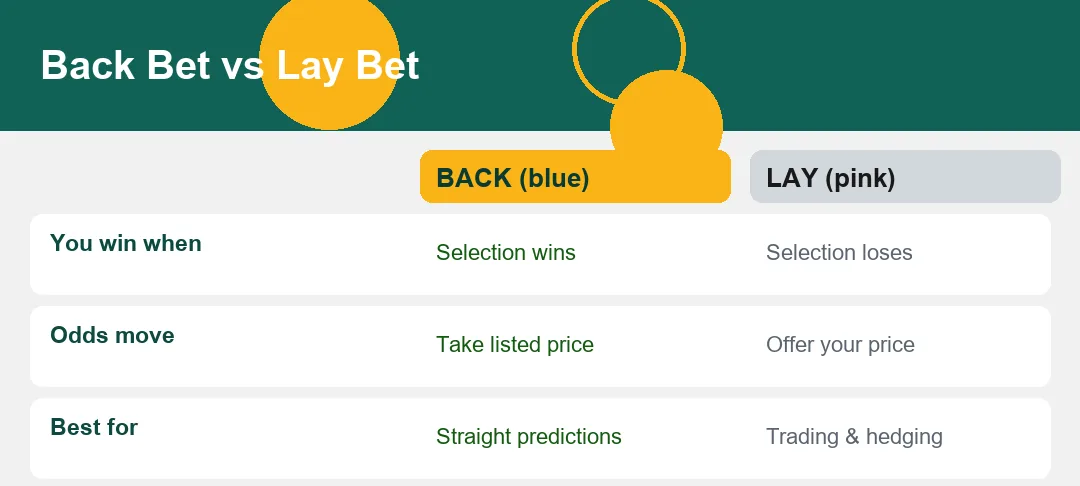
Blue backs. Pink lays. Once this clicks, bookmakers feel like a bad deal forever.
On every Cricbet99 market you see two prices: the blue back price and the pink lay price — exactly the motif this site's tables use.
- Back India at 2.10 — India wins, you win 1.10× your stake.
- Lay India at 2.12 — India loses or draws, you keep the backer's stake.
- Do both at different prices — and you've locked a profit whatever happens. That's trading.
The odds themselves are set by players, not a bookmaker — which is why exchange prices are consistently better. See how exchange odds work for the probability math.
The Markets Your ID Unlocks

Match Odds
The classic 1-X-2 market on every T20, ODI, Test and IPL fixture — biggest liquidity, tightest prices.
Session & Fancy
Runs-in-overs brackets, player milestones, wicket markets — 100+ side markets on marquee matches. Start with the session guide.
Other Sports
Football, tennis, horse racing and more, all with the same back/lay mechanics.
Live Casino
Teen Patti, Andar Bahar, roulette and dealer tables between innings — one balance across everything. See all features.
Exchange vs Bookmaker — Why It Matters

A bookmaker builds a 6–10% margin into every price and can limit winners. An exchange charges a small transparent commission on net winnings only — and the lay side means you're never stuck with a bad position.
Curious how Cricbet99 compares with fixed-odds books? Read Cricbet99 vs Parimatch and vs Betway.
Reading a Live Market Screen
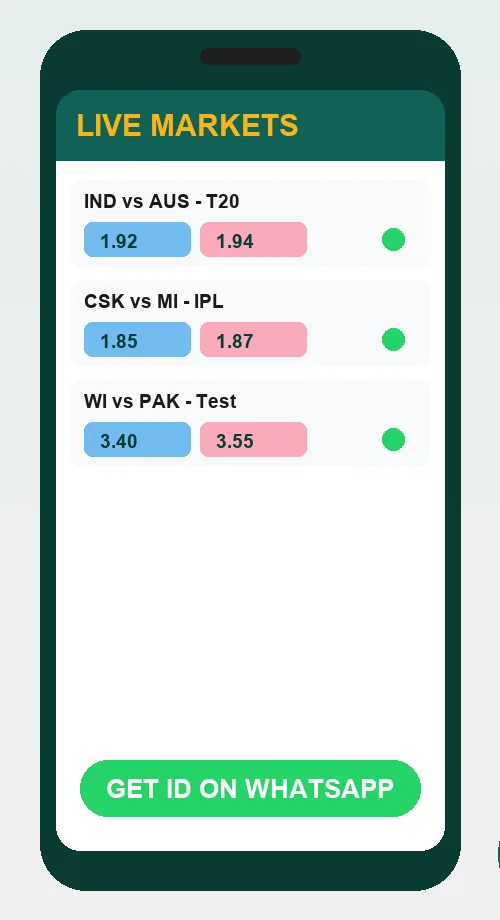
The mobile screen beside this text is what the exchange actually looks like on a match night, and learning to read it takes about one over of real play. Walk through it element by element.
The match list. Each row is a live or upcoming fixture. The green dot means in-play — prices are moving ball by ball. Tapping a match opens its full market board; the two numbers you see on the list are the current best back and lay prices on the first main market, your at-a-glance read on where the game stands.
The blue and pink cells. Blue is always back — the price you get if you bet the outcome happens. Pink is always lay — the price at which you can take the other side. The gap between them, usually one or two ticks on a liquid match, is the spread. Tight spreads are the visible signature of a healthy market: they mean plenty of money is waiting on both sides and you can enter or exit a position at close to fair value.
The stake box. Tap a price and the bet slip opens: enter your stake, see your exact profit (for backs) or liability (for lays) before confirming. Nothing is committed until you confirm, and unmatched bets — offers waiting for someone to take the other side — can be cancelled freely. That last point is a genuine exchange feature: you are allowed to ask for a better price than the market currently shows and wait to be matched.
Your position line. Once you hold bets in a market, the panel shows your net result per outcome — green numbers where you profit, red where you lose. Trading, at its core, is just working those numbers until they are green everywhere, which is exactly what the back-vs-lay guide teaches with real figures.
Liquidity: The Exchange's Heartbeat
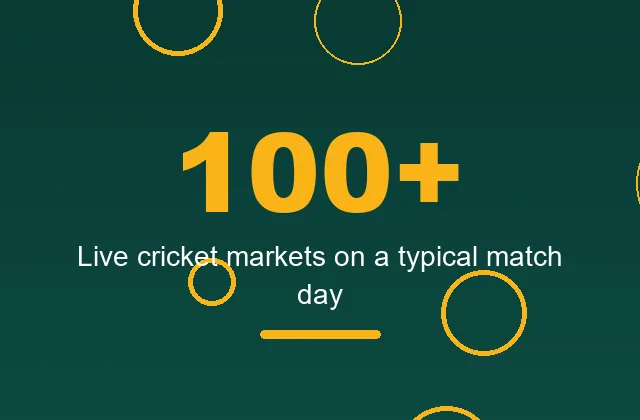
The number beside this text — a hundred-plus live markets on a big match day — describes breadth. Liquidity describes depth: how much money is actually waiting to be matched at each price, and it is the single most underrated concept for new exchange players.
On high-liquidity markets — IPL match odds, international T20s, World Cup fixtures — thousands of players are quoting both sides, spreads sit at a tick or two, and any realistic stake matches instantly at the price you see. This is where exchange betting feels magical: better prices than any bookmaker, instant matching, and the freedom to exit whenever you choose.
On low-liquidity markets — an associate international at 4 a.m., the seventeenth fancy market on a domestic game — the spread widens and large stakes may only partially match. Nothing is wrong when that happens; the market is simply thinner. The professional habits: check the spread before staking (a wide spread is the market telling you it is quiet), scale stakes to the market's depth, and on thin fancy boards prefer the main session lines where the action concentrates.
The rhythm across a match night is predictable and worth internalising. Liquidity builds through the day, surges at the toss, peaks during the powerplay and death overs, and thins in the middle overs — the same windows that drive the price swings mapped in our IPL guide. Trade the surges; respect the lulls.
Exchange Strategy: The Foundations That Survive
Strategy content in this niche is mostly fantasy. What follows is the opposite — the four foundations that every consistently sensible exchange player we have serviced actually shares, whatever their style.
Bet the gap, not the feeling. An exchange price is a probability statement: 2.00 means the market says fifty-fifty. The only rational bet is one where your honest estimate differs from the market's — back when you are higher, lay when you are lower, pass when you agree. "I have a feeling about tonight" is not a gap; a venue that chases at 65% priced like a coin flip is. The conversion arithmetic lives in the odds guide and becomes automatic within a week.
Trade the innings, not the result. The lay side means you never have to ride a bet to the finish. Back at 2.10, lay at 1.60, and the result stops mattering — you hold guaranteed profit. Players who internalise this stop thinking in "wins and losses" and start thinking in entries and exits, which is calmer, more repeatable, and considerably better for sleep.
Respect the commission line. The platform's 2–3% commission on net winnings is the fairest fee structure in betting, but it still defines your break-even: an edge that only exists before commission is not an edge. Practical rule — if a trade's locked profit would be pennies after the haircut, the trade was entertainment, not strategy. Entertainment is allowed; just label it honestly.
Protect the bankroll like it's the strategy — because it is. Flat small stakes, a per-match cap, and the willingness to end a session early beat any prediction model over a season. The exchange will still be here tomorrow; bankrolls that chase tonight's loss often are not. Our limit tools make the cap enforceable by someone other than your midnight self, which is exactly when it matters.
Cricbet99 Exchange FAQs
What is the Cricbet99 exchange?
It is a peer-to-peer betting marketplace: players bet against each other instead of against a bookmaker. You can back an outcome to happen or lay it not to happen, and prices move with real supply and demand.
What is the difference between back and lay?
A back bet wins when your selection wins. A lay bet wins when your selection loses — you play the bookmaker's side. Using both on the same market is how traders lock in profit. Full examples in our back vs lay guide.
Does Cricbet99 charge commission?
A small commission applies on net winnings per market — typically a low single-digit percentage, and nothing on losing markets. It replaces the much larger hidden margin bookmakers build into odds. Details in the commission guide.
Which cricket markets does the exchange cover?
Match odds, innings runs, over-by-over session lines, player runs, wickets, boundaries and dozens more fancy markets on big matches — see session betting and fancy bets.
Can I trade in-play on Cricbet99?
Yes. Prices update ball by ball, and you can back then lay (or the reverse) at different prices to secure a profit before the result is known.
How do I get a Cricbet99 exchange ID?
Message us on WhatsApp — the ID covers the full exchange plus casino. The registration steps take about two minutes.
What does it mean when my bet is "unmatched"?
You offered a price and no one has taken the other side yet. Unmatched bets sit in the queue until matched, cancelled by you, or the market closes. You can cancel them freely at any time — a genuine advantage over bookmakers, where a placed bet is final the moment you tap.
What is the spread and why does it matter?
The gap between the best back price and best lay price. A one-tick spread on an IPL match means deep liquidity and near-fair pricing; a five-tick spread on a quiet market means entering and exiting costs you real value. Checking the spread before staking is a thirty-second habit that saves serious money over a season.
Can my exchange bets be voided?
Markets follow published settlement rules: abandoned matches void match odds, incomplete sessions void per the panel's session rules, and obvious price errors can be corrected — in both directions. Every settlement is recorded in the bet log, and any query about one is checked against it in chat.
Is exchange betting harder than bookmaker betting?
It has one more concept to learn — the lay side — and everything else is easier: prices are honest, exits are possible, and the interface shows your exact position at all times. A bookmaker user typically needs one full match to feel at home on the ladder. The learning investment repays itself in better odds from the first bet onward.
Why do prices sometimes jump several ticks at once?
Because something happened: a wicket, a dropped catch, a rain update, a big matched bet. Exchange prices are live probability, so news moves them instantly. The jump is not a glitch — it is the market repricing reality faster than commentary can describe it, and reading those jumps is where in-play traders make their living.
Does the exchange ever bet against me like a bookmaker?
No — that is the structural point of the model. The exchange is a neutral marketplace matching player against player and earning commission on winnings regardless of who wins. It has no position in any market and no interest in your losing, which is why exchanges never limit or ban winning players the way bookmakers routinely do.
Can I use the exchange for small stakes, or is it for high rollers?
Small stakes are genuinely welcome — minimum bets are modest, and the trading mechanics work identically at 100 as at 100,000. Most experienced players started with a week of minimum-stake learning. Liquidity on major matches is deep enough that stake size only becomes a consideration on the thinnest fancy markets.
Which markets have the best liquidity for beginners?
Match odds on internationals and IPL fixtures, without question — the deepest money, the tightest spreads, and the most forgiving place to learn entries and exits. Main session lines on the same matches come next. Save the exotic fancy markets for after the ladder feels like home.

Trade the Next Match
Get an exchange ID on WhatsApp and see live back/lay prices within minutes.
Get Cricbet99 ID on WhatsApp